From the Editor’s Desk
This month, the U.S. crossed a grim financial threshold: we now owe more in debt than we produce in GDP every year. Closing that gap will require hard political choices Washington has dodged for decades. But one part of the answer is more straightforward—using technology to help government do more with what it already spends.
That idea moved to the center of the national conversation last year through DOGE, which promised $2 trillion in cuts. DOGE fell far short, eventually claiming $215 billion in savings, most of which journalists couldn't verify. But it did push agencies to experiment with AI at the exact moment the technology became capable of delivering real results. And that appetite for tech-driven efficiency, in turn, is spurring the emergence of a new ecosystem of startups built to help government save time and money.
Let’s dig in.
How Is Government Using AI for Cost Savings?
A primary target is improper payments (money the government sends out in error). According to the Government Accountability Office, agencies made an estimated $186 billion in these payments during FY 2025 alone. Since FY 2003, improper payments have totaled roughly $3 trillion.
A few early examples of agencies using AI to chip away at the problem:
- Treasury's AI-supported payment integrity system, whose use accelerated under DOGE, has scaled quickly, saving taxpayers $652.7 million in FY2023, $4 billion in FY2024, and $11.7 billion in FY2025.
- CMS launched a Fraud Defense Operations Center in March 2025 that uses AI to flag suspicious Medicare claims. Deputy Administrator Kim Brandt recently claimed the system saved taxpayers over $2 billion in less than a year.
- The VA is using AI to help identify fraudulent direct deposit changes intended to steal veterans’ benefit payments.
The federal government’s capacity to deploy these tools got a boost in August 2025 when GSA approved the leading LLMs for use. But these are early days, and government will need partners in the work.
Opportunity for GovTech Founders
That's where a new wave of startups comes in. Government efficiency is itself a venture scale-business; even a modest improvement in time or payment savings for a program like Medicare translates into billions of dollars of value. Among these startups:
- Commonweal portfolio company Advocate is building a TurboTax-style platform for federal benefit programs, starting with disability insurance. Its AI system helps individuals assemble complex applications for federal disability insurance and helps the US government to screen those applications. We invested at pre-seed in 2022 and they’ve since raised follow-on funding from Khosla Ventures, Lerer Hippeau, and others.
- IVIX is building a platform to help tax authorities like the IRS crack down on tax evasion by using AI to identify unreported business activity. They claim to have uncovered $1 billion in previously unreported revenue so far. They raised $60M in Series B funding last year led by O.G. Venture Partners with participation from InsightPartners, Citi Ventures, and others.
- Tracklight is building AI to detect fraudulent claims for state and federal benefit programs. They raised $3M in seed funding from BarronKent and Growth Factory in 2024.
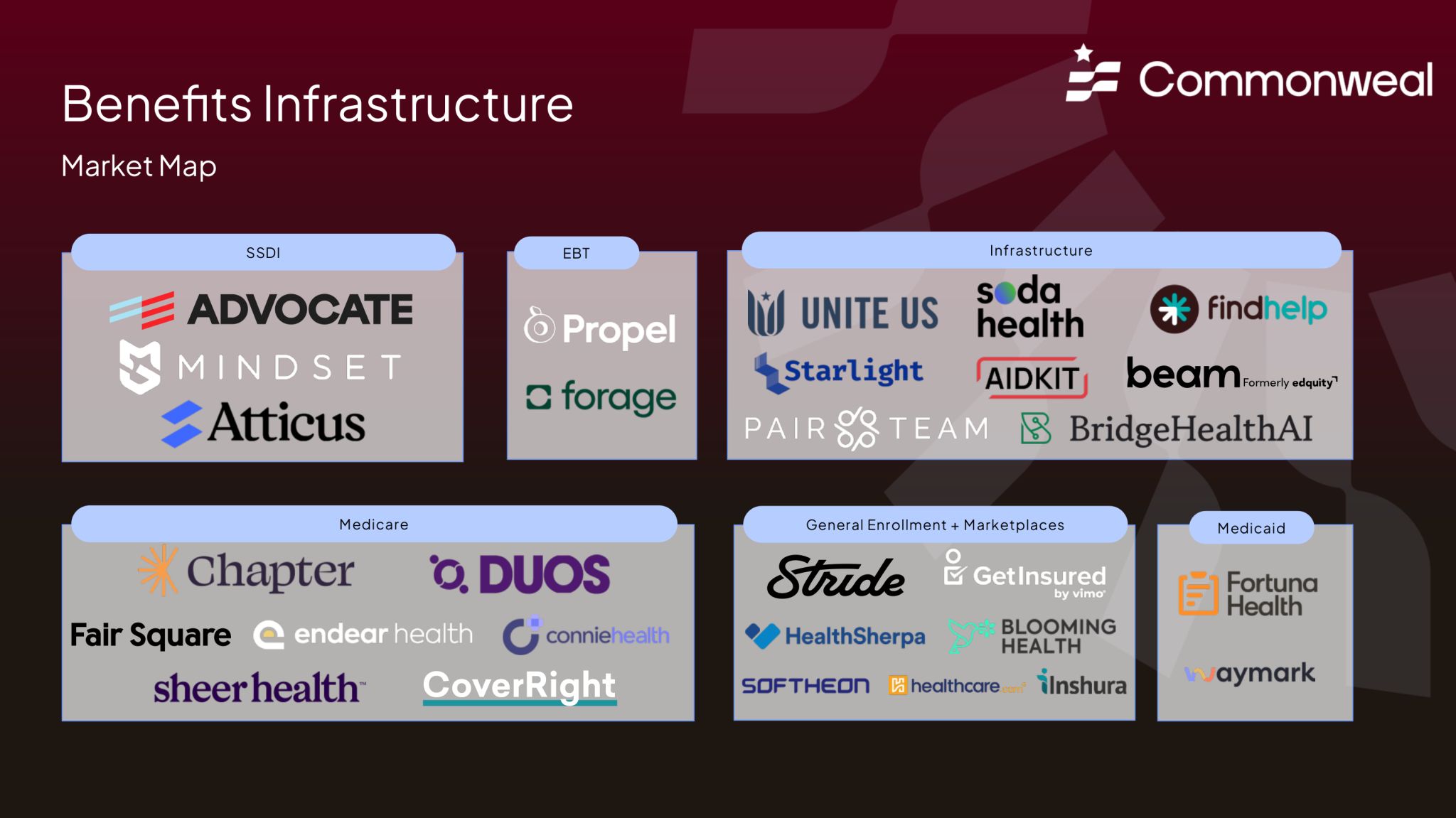
Last year, we mapped out the venture ecosystem in just one corner of this world: benefits delivery. Most of the companies on that map are working on some version of cost or time savings, and the category already includes unicorns Chapter and Unite Us.
The Bottom Line
The fiscal math around our national debt won't be solved by government efficiency tech alone, but the opportunity is real, and the founders building in this space have an eager partner in government. We are investing accordingly.